
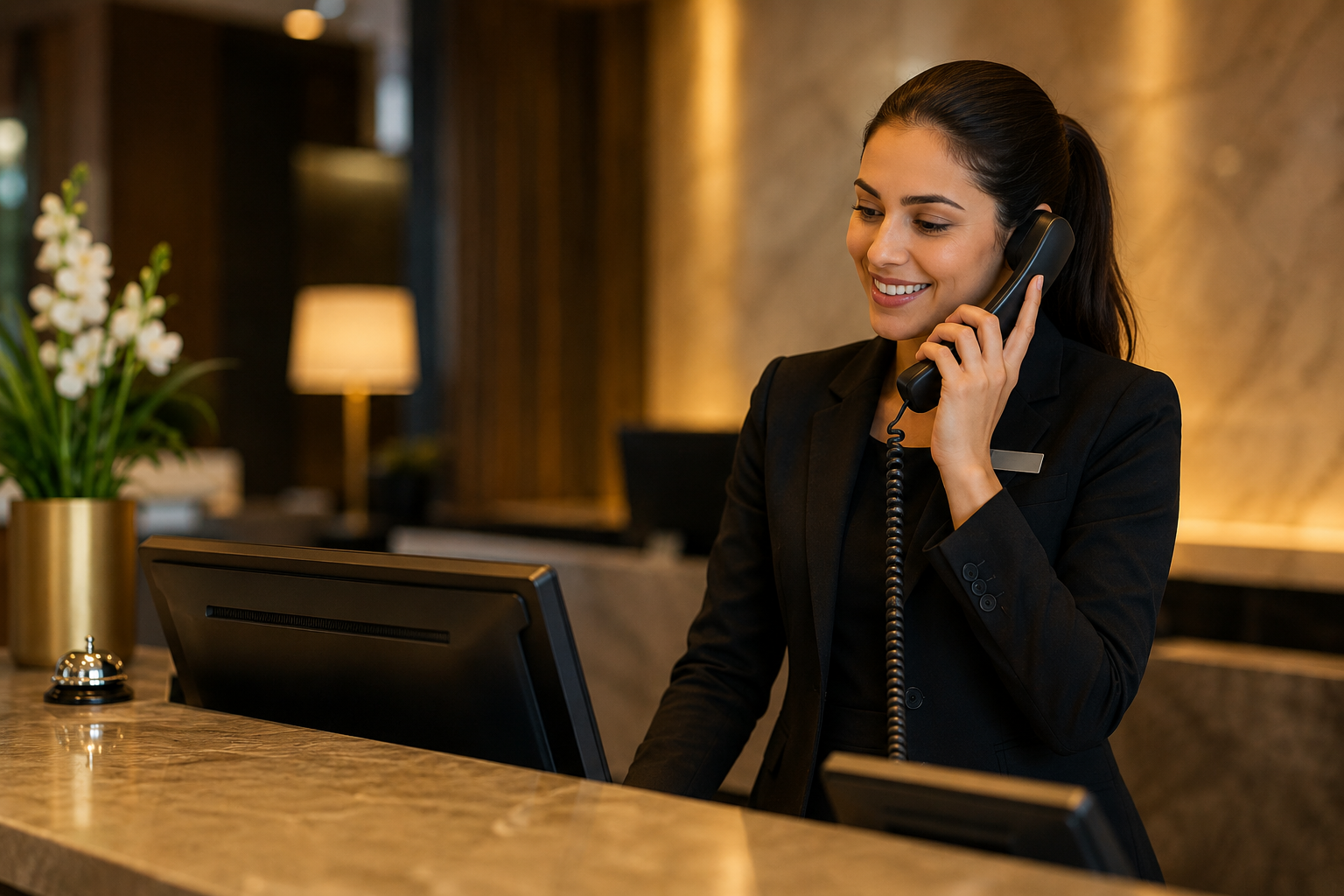
Hotels do not usually miss reservation calls because their front desk team is ignoring the phone. They miss them because the same employee who is expected to answer the phone is also checking in guests, resolving problems, processing payments, coordinating with housekeeping, handling late arrivals, and covering dozens of other responsibilities throughout a shift.
That creates predictable gaps in phone coverage, particularly during check-in, overnight hours, shift changes, weekends, and other periods when staffing is thin or guest activity is high.
For hotel operators, those unanswered calls are more than a service issue. A guest calling the property directly is often showing strong booking intent. If nobody answers, the guest may call another hotel, abandon the booking entirely, or move to an online travel agency where the hotel may pay a commission that could have been avoided through a direct reservation.
A hotel answering service closes that gap by giving callers access to a live person when the onsite front desk cannot answer. The right model can extend reservation and guest-service coverage around the clock without requiring the hotel to staff another employee at the desk for every shift.
This guide explains where reservation calls are most commonly missed, how to estimate the revenue exposure at your own property, and what hotel operators should look for when evaluating 24/7 call coverage.
What Is a Hotel Answering Service?
A hotel answering service provides live phone coverage for a hotel when the onsite front desk is unavailable, overloaded, or not staffed.
Depending on how the service is configured, a trained remote agent may:
- Answer calls in the hotel’s name
- Respond to common guest questions
- Support reservation inquiries
- Provide property information
- Route calls to the correct person or department
- Follow property-specific escalation procedures
- Assist guests during overnight or high-volume periods
The important distinction is that a hotel answering service is not simply voicemail or an automated phone tree.
The objective is to give a guest access to a real person who understands the property and can move the conversation forward instead of asking the caller to leave a message and hope somebody calls back.
For many independent, select-service, economy, and extended-stay hotels, that additional coverage becomes an extension of the front desk rather than a separate call center.
Why Hotels Miss Reservation Calls
The missed-call problem is largely structural. Hotel front desks are designed around employees handling several responsibilities at the same time, while phone demand continues regardless of what is happening in the lobby.
Understanding where those collisions occur is the first step toward fixing them.
The Front Desk Is Already Serving the Guest in Front of Them
A reservation call can arrive while an employee is:
- Checking in a family
- Resolving a payment issue
- Replacing a room key
- Explaining a deposit policy
- Handling a guest complaint
- Coordinating with housekeeping or maintenance
In most situations, the person physically standing at the desk receives priority.
The phone continues ringing until the employee becomes available, the caller hangs up, or the call reaches voicemail.
That tradeoff may be unavoidable for the employee, but it still creates lost booking opportunities for the property.
Overnight Staffing Creates the Largest Coverage Gaps
Many limited-service hotels operate overnight with one night auditor responsible for both front desk coverage and operational duties.
When that employee steps away from the desk, assists a guest, prepares reports, investigates a property issue, or handles another call, there may be nobody else available to answer the phone.
The problem is especially important because overnight callers are not necessarily low-value callers. They may be:
- Dealing with a delayed flight
- Looking for a same-night room
- Planning an early arrival
- Calling from another time zone
- Trying to confirm a reservation before traveling
Their need can be immediate, which means voicemail is unlikely to hold the opportunity for long.
Peak Check-In Hours Create Competing Demand
The late afternoon and early evening are naturally busy at the front desk.
Arriving guests need to be checked in at the same time prospective guests are calling about:
- Rates
- Availability
- Parking
- Pet policies
- Room types
- Same-night reservations
- Check-in requirements
Even a well-trained employee can only handle one conversation at a time.
When the lobby gets busy, calls become the easiest interaction to defer because the caller is not standing directly in front of the employee.
Shift Changes Create Small but Repeatable Gaps
Call coverage can also weaken around shift handoffs.
Employees may be:
- Reconciling information
- Logging into systems
- Reviewing outstanding guest issues
- Exchanging keys or cash drawers
- Briefing the next employee on property activity
These gaps may only last a few minutes, but they occur every day.
Across hundreds of shifts over the course of a year, short periods of inconsistent coverage can add up to a meaningful number of unanswered calls.
New Employees May Answer Without Converting the Reservation
A call does not need to go unanswered to become a lost booking.
Front desk turnover can create another problem: an employee answers but is not yet comfortable navigating the PMS, explaining room types, quoting rates, answering policy questions, or moving a high-intent caller toward a reservation.
The hotel technically answered the phone, but the booking opportunity still disappeared.
That is why call coverage should be measured by more than answer rate alone. Operators should also look at whether the person answering has enough property knowledge and system access to actually help the caller.
How Much Can Missed Hotel Reservation Calls Cost?
There is no credible universal dollar value for a missed hotel call because the economics vary significantly by property.
A better approach is to calculate the potential exposure using your own booking data.
Use This Missed-Call Revenue Formula
Missed booking-intent calls × expected phone conversion rate × average length of stay × ADR = estimated room revenue exposure
Consider a hotel that misses six genuine reservation inquiries per day.
Assume:
- 6 missed booking-intent calls per day
- 30% expected conversion rate
- 2-night average length of stay
- $120 ADR
The estimated revenue exposure would be:
6 calls × 30% conversion × 2 nights × $120 ADR = $432 per day
Over a 30-day month, that represents approximately:
$12,960 in potential room revenue exposure
That does not mean every missed caller would have booked, nor does it mean every booking is permanently lost.
The purpose of the calculation is to give operators a practical way to quantify whether additional phone coverage is worth investigating.
Missed Calls Can Also Increase OTA Dependency
The next layer is distribution cost.
If a caller cannot reach the hotel directly but ultimately books the same property through an OTA, the room may still be sold, but the hotel can incur a commission that would not have applied to the direct phone reservation.
OTA commissions commonly fall in the 15% to 25% range, depending on the platform, property, market, and program.
A missed direct reservation call can therefore hurt the hotel in two different ways:
- The hotel loses the booking entirely
- The booking returns through a more expensive distribution channel
When Are Hotels Most Likely to Miss Calls?
Hotels should not assume their phone coverage problem is evenly distributed throughout the day.
Most properties have a handful of recurring windows where calls are substantially harder for the onsite team to manage.
Overnight Hours
Overnight is the most obvious risk period because staffing is usually at its lowest.
A single employee may be responsible for:
- Arrivals
- Guest issues
- Night audit responsibilities
- Security-related procedures
- Operational work
- Phone coverage
If that employee is unavailable for even a few minutes, there may be no second person to pick up the call.
Hotels without overnight desk coverage have an even clearer problem: unless calls are forwarded somewhere else, every live inquiry during those hours depends on voicemail or a callback the next morning.
Peak Check-In Periods
During the busiest arrival windows, phone demand competes directly with lobby demand.
The problem becomes more pronounced at properties where one person is expected to handle the entire desk.
A guest calling to book a room may hear the phone ring while the onsite agent works through a line of arrivals.
Weekends and Holidays
Weekend travel demand often rises while hotel staffing can become more difficult to schedule.
Holidays can create the same mismatch, particularly when demand is strong but employees are taking scheduled time off or managers are trying to avoid excessive overtime.
The result is a predictable period when reservation value may be high while available front desk capacity is limited.
Breaks, Property Walks, and Unexpected Guest Issues
Coverage gaps also happen during ordinary operational moments that rarely appear on a staffing plan.
An employee may:
- Step away to help a guest
- Inspect a room issue
- Take a meal break
- Handle a maintenance problem
- Walk another part of the property
None of these events is unusual, but the phone does not know that the desk is temporarily unavailable.
How Hotels Can Reduce Missed Reservation Calls
There is no single solution that works for every property.
The right approach depends on call volume, staffing levels, operating model, PMS setup, and how much responsibility the hotel wants the answering team to handle.
Most properties improve coverage through a combination of the following approaches.
1. Measure Your Actual Missed-Call Pattern
Before changing staffing or buying another service, establish the baseline.
Review your phone reporting and identify:
- Total inbound calls by day and hour
- Answered versus unanswered calls
- Average hold time
- Call abandonment
- Overnight call volume
- Calls during peak check-in periods
- Repeat calls from the same number
- Reservation inquiries that resulted in bookings, when trackable
A hotel that misses most calls between midnight and 6 a.m. has a different problem from a property that loses calls between 4 p.m. and 7 p.m. because the lobby is consistently busy.
The coverage model should be designed around the actual gap.
2. Use Call Forwarding for Basic Overflow
Call forwarding is one of the simplest ways to create backup coverage.
A property can route unanswered calls to:
- Another employee
- A manager
- A centralized reservation team
- An external hotel answering service
This can work well for low-volume periods.
However, forwarding every unanswered call to the general manager simply transfers the interruption rather than solving it.
The model becomes much more useful when the destination is a person or team specifically responsible for answering hotel calls.
3. Use IVR for Routing, Not as a Replacement for Every Conversation
Interactive voice response can reduce unnecessary live call volume by helping guests reach the correct department or access simple information.
IVR may be useful for:
- Directions
- Department routing
- Property hours
- Frequently requested recorded information
Reservation calls are different.
A guest may want to:
- Confirm a room type
- Ask whether parking is available
- Understand a pet policy
- Discuss a late arrival
- Confirm availability
- Understand the total price before booking
The more questions a caller has, the more valuable access to a knowledgeable person becomes.
An IVR should make that conversation easier to reach, not stand between the guest and the person who can complete it.
4. Give Whoever Answers Access to Accurate Property Information
Answering quickly does not help if the person on the other end cannot provide reliable information.
A hotel answering service should be configured around the property’s actual operating details, including:
- Approved hotel policies
- Amenities
- Check-in and check-out procedures
- Parking information
- Frequently asked questions
- Escalation paths
- Property-specific instructions
- Relevant reservation information
Where reservation workflows are included, access to accurate availability and reservation information can be especially important.
Otherwise, the agent may still need to send the caller back to the hotel for answers, which defeats much of the value of extended coverage.
5. Create Clear Escalation Rules
Not every guest request should be handled remotely.
Properties should document:
- What the answering team can resolve independently
- What requires manager approval
- What should be routed to an onsite employee
- What qualifies as an emergency
- What should be documented for the next shift
This is where a hospitality-specific answering service has an advantage over a generic call center.
Hotel calls frequently involve:
- Property policies
- Room access
- Late arrivals
- Guest complaints
- Maintenance issues
- Reservation changes
- Refund questions
- Payment issues
The goal is not simply to answer more calls.
The goal is to answer them consistently and know exactly what should happen next.
Hotel Answering Service vs. Hiring Another Front Desk Employee
The decision is not always one or the other.
A full-time onsite employee provides physical presence and can handle responsibilities that require someone to be at the property.
A remote answering service provides flexible call and guest-support coverage that can extend beyond the hours or capacity of the onsite team.
For many hotels, the strongest operating model uses both.
Onsite Staff Can Focus On
- Physical guest interactions
- Property inspections
- Room access
- Cash handling
- Maintenance coordination
- Issues requiring physical presence
Remote Hotel Support Can Help With
- Incoming phone calls
- Reservation inquiries
- Common guest questions
- Overflow calls
- After-hours requests
- Call routing
- Supported digital guest-service workflows
That distinction matters because adding another employee solely to keep the phone covered can be expensive, particularly if call volume is inconsistent throughout the shift.
Shared or remote coverage allows a hotel to increase availability without necessarily adding another complete onsite staffing position.
How Kiotel Supports 24/7 Hotel Phone Coverage
Kiotel provides live virtual guest support for hotels, including configured phone workflows, guest questions, service requests, after-hours assistance, and property-specific escalation.
Rather than operating as a generic answering service with the same script for every business, Kiotel is built specifically around hotel operations.
The service can be configured around a hotel’s:
- Coverage requirements
- Property procedures
- Guest-service workflows
- Systems
- Escalation rules
- Operational preferences
That can be especially useful for properties trying to solve several related issues at the same time:
- Missed reservation calls
- Overnight guest support
- Front desk workload
- Late arrivals
- Inconsistent coverage during busy periods
- Owner or manager interruptions after hours
Kiotel can also operate alongside the rest of a hotel’s front desk environment, including supported PMS, phone, payment, door-lock, kiosk, and operational workflows.
The objective is not to create another disconnected vendor that the hotel has to manage. It is to extend the operating capacity of the front desk.
For a broader overview of this model, read our guide to the virtual hotel receptionist and how hotels use remote support alongside onsite staff and self-service technology.
What to Look for in a Hotel Answering Service
Hotel operators should evaluate more than whether a provider can pick up the phone.
The more useful question is whether the service can become a reliable extension of the property.
Hospitality Experience
Hotel calls are different from calls to a law firm, medical office, or home-services business.
Agents need to understand:
- Guest expectations
- Reservation terminology
- Property policies
- Escalation procedures
- Hotel operating workflows
Coverage That Matches Your Actual Gaps
Some hotels need overnight coverage.
Others need:
- Peak-hour overflow
- Weekend coverage
- After-hours coverage
- Shared coverage across several properties
The service should fit the operating model rather than forcing the hotel into a generic package.
Property-Specific Knowledge
Guests should not feel as though they reached an unrelated third-party call center.
The answering team should understand the hotel’s:
- Policies
- Hours
- Amenities
- Directions
- Parking information
- Check-in procedures
- Common guest questions
Clear Reporting
Operators should be able to understand:
- How many calls were handled
- When calls occurred
- What types of requests were received
- Where escalations occurred
- Whether missed-call coverage is improving
Without reporting, it is difficult to determine whether the service is actually reducing missed calls and improving coverage.
Integration With Hotel Workflows
The more a service can work with the hotel’s existing systems and operating procedures, the more useful it becomes.
A phone call should not create a second disconnected process that the onsite team has to reconcile later.
How to Determine Whether Your Hotel Needs an Answering Service
Start with three questions.
Are Reservation or Guest Calls Regularly Going Unanswered?
If the answer is yes, quantify when and how often it occurs.
You cannot fix a coverage problem until you know where the coverage gap exists.
Are Onsite Employees Frequently Interrupted by Calls While Serving Guests?
If phone demand consistently competes with in-person service, overflow coverage may improve both experiences.
The guest in the lobby gets more focused attention, while the caller still reaches someone who can help.
Are Managers or Owners Acting as the Default Backup After Hours?
If every overnight call, guest question, or escalation eventually reaches the owner’s cell phone, the property has not actually solved its coverage problem.
It has simply moved it.
A hotel answering service becomes especially compelling when the cost of coverage is lower than the combination of:
- Lost reservations
- OTA commissions
- Overtime
- Additional staffing
- Management interruption
- Guest-service inconsistency
Frequently Asked Questions About Hotel Answering Services
What Is a Hotel Answering Service?
A hotel answering service provides live phone coverage when the onsite front desk cannot answer.
Depending on the service, agents may handle reservation inquiries, guest questions, call routing, after-hours assistance, and property-specific escalation.
Can a Hotel Answering Service Take Reservations?
Some hotel answering services can support reservation workflows when they have the appropriate property information, system access, and authorization.
Hotels should confirm exactly what the provider can view, change, or book before implementation.
Can a Hotel Answering Service Provide 24/7 Coverage?
Yes.
Many providers offer after-hours or 24/7 coverage. The hotel should choose coverage based on its actual call patterns rather than assuming every property needs the same schedule.
Is a Hotel Answering Service the Same as a Virtual Hotel Receptionist?
The terms overlap, but they are not always identical.
A hotel answering service is primarily focused on phone coverage.
A virtual hotel receptionist may support a broader range of front desk responsibilities through:
- Phone
- Messaging
- Kiosks
- Video
- Remote guest-service workflows
Does a Hotel Answering Service Replace Onsite Staff?
Not necessarily.
Many hotels use remote answering or virtual front desk coverage to support the onsite team rather than replace it.
The remote team handles calls and other supported workflows while onsite employees focus on tasks that require physical presence.
How Can a Hotel Reduce Missed Reservation Calls?
Start by measuring when calls are missed, then add coverage around the highest-risk periods.
Common solutions include:
- Call forwarding
- Overflow routing
- Better phone reporting
- Documented escalation procedures
- Property-specific call handling
- Hospitality-specific live answering coverage
Stop Treating Unanswered Calls as an Unavoidable Part of Hotel Operations
A missed reservation call may look like a small front desk problem, but repeated across nights, weekends, shift changes, and busy check-in periods, the financial impact can become meaningful.
The solution does not have to be another full-time employee sitting behind the desk waiting for the phone to ring.
Hotels can combine better call routing, clearer procedures, accurate property information, and live remote coverage to make the front desk more accessible without placing every interaction on the onsite team.
If your property is regularly:
- Sending callers to voicemail
- Relying on a manager’s cell phone after hours
- Missing calls during check-in
- Asking one employee to choose between the guest in the lobby and the guest on the phone
…it is worth measuring the gap.
Kiotel helps hotels extend live guest and phone coverage around the clock while connecting support to the rest of the property’s operating workflows.
Book a demo to see how Kiotel can help your hotel keep the front desk available 24/7 without adding unnecessary operational complexity.